Showing posts with label Sufi. Show all posts

Thursday, 28 February 2008

A Jihad for Love

Picture credit : Hetgras


Parvez Sharma the director of A Jihad for Love being interviewed on the tv show The Hour.
Video Uploaded by TheHour

Yesterday was an eventful day after the monotony of the past few days. I met a guy in the city who I got in touch with over the internet. The guy had also done a course in cookery from TAFE the same campus as me but not is French Cuisine. I though that it would be nice to exchange notes with him. But I was taken aback by the meeting. All that this guy did was proclaim his admiration for Indian cuisine and disgust at most western culinary traditions. I thought that it was rather strange that he would do a course in a culinary tradition that he didn't have any interest in. Luckily for me as always Garfield came to my rescue. I took the guys leave in time as I was supposed to meet Garfield and go to see a screening of "A Jihad for Love".
The movie is a documentary about homosexuality in the Islamic world and how people are torn apart because at times they feel that their sexuality is in conflict with the teachings of Islam. I was moved to tears on watching some of the stories in the movie especially on hearing the conversations between mothers and their gay sons. It reminded me of mum and how she has always been there for me and accepted me with an open heart and also the men in my life (especially Mr Big) and how she had showered them with unconditional love. Another theme that resonated with me was how most gay men in order to escape persecution in their country are forced to leave their entire life behind and move to foreign shores hoping that in their new home they would be able to live their life without having to always be on a guard about being outed and bringing 'shame' to the family name or being pressurized to get married by family or relatives. That is one reason that I left India thinking Australia would be different but some of the bubbles have burst since I have arrived here. The saddest part has been to see the discrimination within the gay community in Australia against people from different cultures and how people are trying to put other people in boxes based on their nationality or colour. It is not just a one way thing. Most Aussie would would want to be with Caucasians or Orientals and most Indians or South Asians would want to be in a relationship with someone who comes from the same 'culture' with similar 'values' and 'morals'. It got me thinking about the guy I met yesterday and how in his case along with his taste in food his taste in men too was very 'conservative' and discriminatory.
Another theme that was covered in the movie and was brought up in the Q&A session with the director and producer after the movie ended was how Sufi mysticism is replete with references to divine love between two men and how in Sufi poetry it has been written about so beautifully that it is almost homo-erotic. Case in point being Rumi's poetry inspired by his 'beloved' Shams of Tabriz, Amir Khusro's poetry dedicated to his 'master' Nizamudin Auliya, and the folklore that was covered in the movie about Madho Lal and Shah Hussain.
As has been in my case the first time that I felt pride and not shame on being gay was when I read the poetry of Rumi and with time I realized that there have been great men in the past that have found love in an another man and it was not 'queer' or 'wrong'. With time I discovered the poetry or Amir Khusro and I have written about it in the past on the blog and how it helped me through some rough patches in life and feel comfortable about my sexuality. Hence it was Sufi music and poetry that did for me what gay pride may have done for some other people. In the East gay prides are a distant dream and until then there is this beautiful literature that can provide some much needed comfort and reassurance to the 'queer (i find this word kinda derogatory)'. I once saw a documentary about the celebration of the festival (Urs) at the Dargah in Delhi of Nizamudin Auliya celebrating the marriage (union) of Amir Khusro and his beloved (Nizamuddin Auliya). The whole ceremony was so very beautiful and the entire dargah was cleaned with milk and rose water and then decorated for the occasion. It was followed up with a performance of Sufi music.
Here is an interesting article about Shah Hussain comparing his works to that of Rumi and other Sufi mystics.

To end the post I am quoting some poetry so that you get an idea of what I am talking about:

Mevlana Rumi

I am seeing a moon outside the eye in the eye, which neither eye has seen or ear heard of.
I do not see tongue and soul and heart save without myself, from that moment that I stole a glance at that cheek.
Had Plato seen the loveliness and beauty of that moon, he would have become even madder and more distressed than I.
Eternity is the mirror of the temporal, the temporal the mirror of pre-eternity - in this mirror those two are twisted together like his tresses.
A cloud beyond the sense whose rain is all spirit; sprinkling on the dust of the body - what rains he has rained!
The moonfaced ones of heaven, seeing the picture of his face, have become ashamed before that beauty and scratched the bank of their necks.
Posteternity took the hand of pre-eternity and took it toward the place of that moon: having seen both, it laughed in jealous pride at the two.
About and around his palace what lions there are, roaring jealously, aiming at the blood of the self-sacrificing, adventurous men.
Suddenly the word jumped from my mouth, 'Who is that king? Shams-al-din king of Tabriz'; and at those words my blood surged.

Translated by A.J. Arberry


Amir Khusrau


I am a pagan (worshiper) of love: the creed (of Muslims) I do not need;
Every vein of mine has become (taut like a) wire; the (pagan) girdle I do not need.
Leave from my bedside, you ignorant physician!
The only cure for the patient of love is the sight of his beloved –
other than this no medicine does he need.
If there be no pilot on our ship, let there be none:
We have God in our midst: the pilot we do not need.
The people of the world say that Khusrau worships idols.
So I do, so I do; the people I do not need,
the world I do not need.


Shah Hussain

My wrist in the beloved’s grip,
I cannot ask Him to leave hold.
Dark is the night, the cloud is dripping,
I suffer it for lack of a messenger,
The tyrant has sent a call.
They alone know what is love and longing,
Who have it in their lives.
Like digging a well in dry land,
With no cart to carry away the sand.
Carrying loads everyday,
You will leave at last.
Says Husain, the humble fakir,
Put thy eyes into mine, O love.

(Translated by Sant Singh Sekhon)

Thursday, 16 August 2007

This is Sufi


For my birthday this year my closest friend's son gave me a Pekingese as a gift. At first I was apprehensive of looking after a dog. I had seen a movie where it said that if you want to test if you are ready for a relationship try looking after a live plant and if the plant survives for a reasonable time move over to a pet and if that too survives think about a relationship.
Sufi (the Pekingese) is really cute and at first I was very attentive to her but later she became my parents responsibility who take her for a walk every morning. My part is feeding her and bathing her and stuff. I just finished giving a very reluctant Sufi a bath. Now that she looked all clean and presentable I thought of posting a few photographs of her I took just now.
The first picture is of when I got her on my birthday and the rest are from today.

Sunday, 12 August 2007

Raqs-e-Bismil (Dance of the wounded)


Nameedanam che manzil bood ke shab jaye man boodam
Bahar su raqs e bismil bood ke shab jaye man boodam
(Amir Khusrau)

I know not of the state
in which I was Last night...
Everywhere the wounded danced in ecstasy
where I was Last night...

Thought and form, poetry and music are integral to Sufism. Sufi music is derived from a state of ecstasy, a dance of the body and soul of those wounded in love...Sufi thought expressed in Persian poetry of the mystic poet mainly Rumi, Khusrau, Saadi and Hafiz, along with Urdu Ghazal is the blending of thoughts in the two genres of mystic expression...

I am quoting a song by Abida Parveen set to music by Muzaffar Ali. It is from my favorite Sufi music album by Abida Parveen called 'Raqs-e-Bismil'. The poetry in this song is mystical and intense to say the least.

Hairat mara ze har do jahan be niaz kard
Een khab kaare daulat e bedaar meekunad
(Rumi)

Bewilderment has absolved me of both the worlds
This is the consequence of awakening from my dreams

Khuli jab ki chashm e dil e hazeen,
to vo nam raha na teri rahi
Hui hairat aisi kuch aankh par ki asar ki be asari rahi
Pari goshe jaan mein ajab nida ki jigar na bejigari rahi
Khabare tahhayyur e ishq sun na junoon raha na pari rahi
Na to tu raha na to main raha jo rahi bekhabari rahi...
(Khamsa by Nazeer Akbarabadi for Siraj Aurangabadi)

The eyes of an anguished heart open...
No longer moist.. Bereft of tears
The perplexed vision
Remained unmoved.. Devoid of response
The soul heard.. An unusual sound
That took the pluck of life away
As wondrous love revealed itself
The fairy vanished..The ecstasy lost
Nor you remained.. Nor I was found
mere oblivion was all there was...

Mujhe bekhudi ye tune bhali chashni chakhayi
Kisi aarzoo ki dil mein nahi ab rahi samayi

O surrender in love,
You have given me a taste that pales all worldliness
No desire remains
In the heart filled with submission

Na hazar hai na khatar hai, na raja hai ne dua hai
Na khayaal e bandagi hai na tamana e khudai

Neither distance nor fear...
neither hope nor prayer
neither thoughts of subjugation
nor desire of godliness

Na muqqam e guftagu hai na mahhal e justaju hai
Na wahan havaas pahunche na khirad ko hai rasai

No place for exchange of words...
no occasion for further quest
Where neither consciousness reaches
nor thoughts transcend its realm

Na makin hai ne makan hai na zameen hai ne zaman hai
Dil e be nava ne mere jahan chhavni hai chayi

No one resides..Neither habitation exist...
Is where this wandering heart has come to camp

Na visaal hai na hijran na suroor hai na gham hai
Jise kahiye khwab e ghaflat so woh neend mujh ko aayi

Where there is no union... No separation
no sorrow... no joy
What is said to be an endless oblivion
I enter such a slumber

(Hazrat Shah Niaz)


Translations by Muzaffar Ali

Painting Credit: Miguel Tio

Sunday, 8 July 2007

Sema

I don't have a very deep understanding of Sufi mysticism but from the little that I have read I understand that for Sufis music and dance is the path to union with God. There are many Sufi orders all over the world and one of them is the Mevlevi Order of Rumi associated with the Whirling dervishes. Music and dance i.e whirling represents Sema or Sama i.e a mystical journey of spiritual ascent through mind and love to "Perfect." In this journey the seeker symbolically turns towards the truth, grows through love, abandons the ego, finds the truth, and arrives at the "Perfect"; then returns from this spiritual journey with greater maturity, so as to love and to be of service to the whole of creation without discrimination against beliefs, races, classes and nations.


I recently read a beautiful article explaining the nuances of the ceremony and am sharing the same with you today:
"...The chanting begins to the accompaniment of the music. Silently, five Mevlevi dervishes or semazen enter single file, wearing costumes that symbolise the death of ego. The hirka or black cloak represents its tomb and the sikke, the slender tapering earth-coloured headdress, is its tombstone. Beneath the cloak is the tenure, a full skirted long white gown depicting the shroud held in place with a black cummerbund.
Walking in circles and bowing to each other in acknowledgement of the centre of Divine Truth within the heart of each. The drumbeat represents the Divine command 'Be'. The flute represents the soul given to universe.
Slowly the dervishes rise from the floor, and casting off the black robes, they fold their arms across their chest with hands hugging the shoulders, and walk slowly. Then, they begin to turn. The position of the arms signifies Unity with God. 
As the whirling gains momentum, slowly the arms are unfurled from across their chest and gravitate upwards as though in total surrender, head inclined at an angle to the right, eyes half closed, intoxicated with love. The graceful movement of the arms- one palm turned upwards, receiving from God, and the other face downward, giving to all.
The whirling is so swift you can no longer distinguish figure from movement, space from time, reality from unreality, or present from past. Then they slow down This was the first cycle of Sema, when the dervishes are viewing all the worlds, the way to reach the grandeur and majesty of God. The lovers are freed from doubt and testify their faith in unity of God. They now slow down, and then once again begins the second cycle. The whole existence is dissolved within this Divine Unity.
During the third cycle the lovers cleanse themselves and reach the level of maturity. In the fourth cycle they arrive at the junction of non-existence within Divine Existence..."

- Narayani Ganesh , Times of India, 07.07.2007

Video Credit: HeyYouImage

Saturday, 7 July 2007

Amir Khusrau


Amir Khusro, a Sufi poet saint, was the disciple of Hazrat Nizamuddin Auliya. A spiritual seeker from the tender age of eight, Amir Khusrau (Khusro) arrived one day at the Khanaqqah (place of congregation for disciples of Sufi saints) of Hazrat Nizamuddin Auliya. He thought to himself "I look for my Pir (teacher) who will draw me to his divine power". And in this quest he composed a quatrain and passed it on to the saint
"Oh mighty King,
You empower the humblest of birds
Perched upon your palace wall
To become a powerful hawk -
Such a meek person waits outside
Will he be beckoned
Or should he go away".

To which the reply came....

"If you are the one who knows the Truth, come in,
Share a moment of divine secrets.
If you know not what I say
Then the path that brought you here
Will take you away".

The saint knew that this was the moment designed by destiny; the moment which would change Khusrau's way of seeing the world. Devotion to his Pir, the subject of his art and channel of quest for God.
One day when Hazrat Nizamuddin Auliya saw people worshipping in different ways on the river Yamuna, he remarked how each person has his own way of reaching God.
"Har quaum raast deene wa qibla gahe..."

to which Khusrau added

"Man qiblah raast kardam bar taraf e kal kulaahe.."
My way to Him is through the one who wears the tilted cap (referring to Auliya).


As part of his quest he also evolved several original Raagas, gave new feelings and meanings to them. He gave sound a new timbre..he gave the music lover the six stringed magic of the Sehtar.. the Sitar.

The poetry of Khusrau is a goldmine of spiritual thought, romance, and wisdom. It connects with secrets so diverse and subtle, wooing the human mind to surrender passionately to the beauty of the Sublime. Through his poetry he walks down the garden of love hand in hand with his beloved as if you and he were one.

He takes you through the rain, the clouds and meadows into the realm of separation and union... you hear the birds, you feel the wind..you feel the tears roll down in the pain of separation...

Excerpts for the CD cover 'The Tilted Cap' by Muzaffar Ali and Shafqat Ali Khan.


The mausoleum of Hazrat Nizammudin Auliya is located in Delhi. The tomb of Amir Khusrau is also located in the complex and the visitors to the Dargah pay their respects to Khusrau before Nizammudin Auliya as a mark of the special bond between the Pir and Murid (the disciple or the one commited to a teacher on the spiritual path of Sufism)


Here are some of Amir Khusrau's poems translated into English from Persian:

The lovers behold your limitless beauty
...A thousand idols fade away

In love I wander in your realm..shed bitter tears
Those who see my plight well up with sympathy

As dark nights engulf you in deep slumber
I count the stars till the break of day...

Though all is not well with Khusrau's heart
Yet, O fair aced beloved, how can I speak ill of thee...


How can I leave my beloved in this enchanting rain
How do i wrench this heart away

Heavens pour as I leave my love
Each weeps in loneliness, each it's own way

Meadows green, the orchards bloom and sway,
But the dark nightingale, in separation, moans miles away

Entangled I am in yours locks and yet, in one stroke,
You have severed my being, parted me from my beloved

O pupil of my eyes, shedding tears of blood
Become one with the bloodshot eyes.. do not get away

Beauty will not last for long if you keep yourself away from Khusrau
Without the thorn a flower wilts soon enough, if plucked away

Wednesday, 20 June 2007

The poetry of Rumi


Paintings by: Sufi Art Gallery, Kuta, Bali (email: sufi_art01@yahoo.com)

I bought these beautiful paintings from an Art Gallery in Kuta, Bali during my vacation there in February 2007. 
I stumbled upon poetry by Rumi while going through the amazing library at Mr. Big's home. For those who haven't read my earlier post Mr. Big was someone I was in a relationship with (my longest relationship no pun intended). I read a couplet written by Rumi (translated to English from Persian) and the simplicity and deep connotations of the couplet made me a ardent fan of his poetry. The couplet was

"When I die,
lay my corpse to rest,
but do not be at all surprised
if His kiss on my tattered lips
brings me back to life"


The story of Rumi's life cannot be condensed but I'll try to do it for you readers. I may have misunderstood parts of his life but I have formed my opinion about him based on my readings which are not complete. Rumi was the son of a famous religious teacher in Konya, Turkey and inherited his father's Khanaqah (kind of monastery where the disciples called Murid and the teacher called Pir would get together and discuss spirituality).  Rumi was famous and highly respected. One day a  wanderer called Shams of Tabriz came to Konya and met Rumi. Both Rumi and Shams were looking for the other half or the medium under whose influence they would be united with their Beloved i.e. God. In each other they found the medium and became inseparable spending all their time together. Rumi's disciples and his family (wife and son) became jealous Shams and Rumi relationship. One day they forced Shams to leave the city. 
Rumi couldn't bear the separation from Shams and send his son in search of him. Shams was brought back to Rumi but the bliss didn't last for long. One day Shams disappeared (rumoured to have been murdered and disposed off). Rumi kept looking for him until one day it dawned upon him that the one he was looking for was already a part of him.  The couplet he wrote on that occasion was
"Why should I seek? I am the same as
He. His essence speaks through me.
I have been looking for myself!"

That's when he started to write his most famous work Diwan-e Shams-e Tabrizi. It is Rumi's disciples who whirl while in a trance trying to attain unity with God through the medium of music and dance (whirling in this case). Sufis believe music (singing praises of the Beloved i.e. God) is the most potent medium of attaining the union with the beloved called Sama which is like a trance like state. Thus his followers are called Whirling Dervishes. Another form of Sufi music popularised in the Indian subcontinent by the disciples of Nizamuddin Auliya and Amir Khusro is Qawwali. The greatest exponent of qawwali was Ustad Nusrat Fateh Ali Khan and now is Abida Praveen you could listen to their music here and here or in my playlist in the sidebar of this blog.

There are many more examples of such close relationships between the Sufi priest and their inspirations (in form of their disciples or just mediums). The story of Nizamuddin Auliya and Amir Khusro from the Indian subcontinent is one such relationship.
I may not the most accurate information about Rumi and if you are interested you could start by looking at Wikipedia. A good collection of his poetry is at Khamush. Then there are book by Coleman Barks and Andrew Harvey which have translations of Rumi's poetry.
When I read Rumi's poetry it resonated with the feeling of emptiness and the search for the beloved within me. Though it took me some time to realize that while Rumi's search was for the Beloved who would unite him with God; mine wasn't all that pure and pious. But I do believe that once we meet the right person he or she would lead to our and their spiritual growth and maturity. I hope someday I meet my medium, inspiration, beloved. That is the top most priority in my 'Life list'(things I intend to achieve before I die).  Yarravilepaul asked me to try to explain why the poetry means so much to me. I could try but I wouldn't be able to. It's like listening to a song 100 times and feeling nothing and then one day in a particular situation you listen to a song and it resonates so much with your situation or state of mind that it leaves you shaken. Rumi's poetry about Shams always resonates with my current state of mind. I don't know if I am making any sense anymore so I would leave it here and post another beautiful poem by Rumi. It's is addressed from me to the medium, inspiration the beloved or in plain terms Mr. Right. Hope it resonates with you.


If anyone asks you
how the perfect satisfaction
of all our sexual wanting
will look, lift your face
and say,
Like this.

When someone mentions the gracefulness
of the nightsky, climb up on the roof
and dance and say,
Like this.

If anyone wants to know what "spirit" is,
or what "God's fragrance" means,
lean your head toward him or her.
Keep your face there close.
Like this.

When someone quotes the old poetic image
about clouds gradually uncovering the moon,
slowly loosen knot by knot the strings
of your robe.
Like this.

If anyone wonders how Jesus raised the dead,
don't try to explain the miracle.
Kiss me on the lips.
Like this. Like this.

When someone asks what it means
to "die for love," point
here.
If someone asks how tall I am, frown
and measure with your fingers the space
between the creases on your forehead.
This tall.

The soul sometimes leaves the body, then returns.
When someone doesn't believe that,
walk back into my house.
Like this.

When lovers moan,
they're telling our story.
Like this.

I am a sky where spirits live.
Stare into this deepening blue,
while the breeze says a secret.
Like this.

When someone asks what there is to do,
light the candle in his hand.

Like this.
How did Joseph's scent come to Jacob?

Huuuuu.

How did Jacob's sight return?

Huuuu.

A little wind cleans the eyes.

Like this.

When Shams comes back from Tabriz,
he'll put just his head around the edge
of the door to surprise us
Like this.

From ˜The Essential Rumi€™, Translations 
by Coleman Barks with John Moyne

Tuesday, 19 June 2007

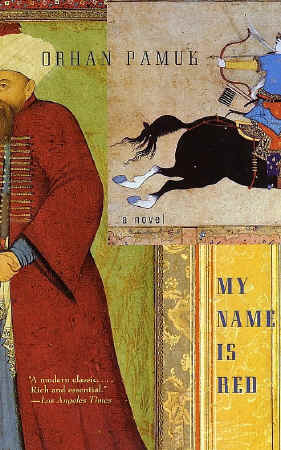
My name is Red


I have nothing much to do nowadays. So all I do most of my time is listen to music, watch movies, read blogs and try to read some books that I have been meaning to read for a long time. One book that I read of late which I enjoyed was "My Name is Red by Orhan Pamuk.
The book is written in a very interesting fashion where each chapter is narrated by one of the characters of the story. In the beginning it takes a while to get used to but it makes the book even more interesting. The other thing that I really enjoyed was the description of Istanbul in such detail that I wanted to just get up and leave for Turkey that very moment. Now it is a part of my 'Life List'. The things that I intend to do before I die along with learning to play the Violin, learning to swim, etc etc. Maybe someday I will make an entry on the blog about my 'Life list'.
The book also explains in great detail the art of Islamic miniature painting. At times it may be a little too descriptive but does add to the charm and element of exotic in the story. I am a believer in the Sufi way of living so for that reason some things about Islam interest me. The book comes highly recommended.